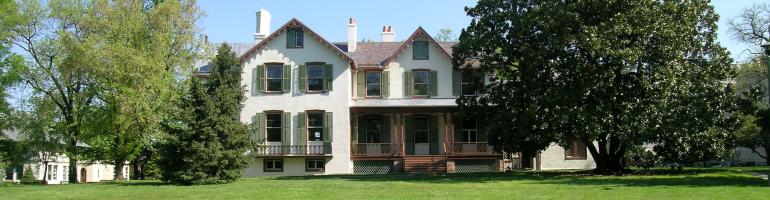
This winter has been unusually snowy for Washington, D.C., leading to numerous opportunities to capture lovely winter wonderland photographs of the Cottage.
February 2, 2010
Cultural Tourism DC Day at Whole Foods Market
Shop DC Whole Foods Market February 3 to Help Support Cultural Tourism DC
Get a taste of DC arts and culture while you grab a bite in the café or shop for groceries at local DC Whole Foods Market stores and help strengthen the future of Cultural Tourism DC. Whole Foods Market will donate five percent of its total store sales on Wednesday, Feb. 3 to Cultural Tourism DC, a nonprofit dedicated to promoting Washington, DC culture and heritage. It’s that simple- just shop, eat, experience and support.
Join us at one of these three DC locations:
-1140 P St., NW (President Lincoln’s Cottage will be at this location from 2-4pm!!)
-2323 Wisconson Ave., NW
-2540 40th St., NW at Tenley Circle
The experience will also incorporate in-store demonstrations from some of Cultural Tourism DC’s member companies, with spoken word, dance performances, photo opportunities and more including:
- Venezuelan, Colombian and Caribbean dance demonstrations from Joy of Motion
- A chance to meet George Washington, courtesy of Madame Tussauds, Washington DC
- DC Trivia with Washington Walks
For a complete schedule of performance times and locations visit: http://www.culturaltourismdc.org/calendar2532/calendar_show.htm?doc_id=204092
January 28, 2010
Evening for Educators Hosted at President Lincoln’s Cottage
By Shira Gladstone
Over the last year and a half, several Civil War related historic sites in the DC area have formed the Civil War Washington Museum Consortium to provide quality professional development for area teachers. This collaboration, made up of President Lincoln’s Cottage, Ford’s Theatre Society, Tudor Place Historic House and Garden, and Frederick Douglass National Historic Site, works with educators to enhance their understanding of Washington during the Civil War through place-based learning techniques. The Consortium offers week-long summer workshops and periodic workshops during the academic year to teachers both local and nationwide.
On Tuesday, January 26th, more than fifty educators from D.C., Maryland, and Virginia attended An Evening for Educators hosted by the CWWMC and held at President Lincoln’s Cottage. This event allowed elementary, middle school, and high school teachers to explore the array of hands-on, engaging programs that the CWWMC has to offer for students of all ages. Museum educators were on hand to answer questions about education programs offered by their respective sites and provide teachers with classroom resources. Educators were also able to explore the Robert H. Smith Visitor Education Center, as well as take a tour of the first floor of the Cottage. The night was a great success in building vital relationships between local teachers and Consortium sites!
For information about teacher and student programs at President Lincoln’s Cottage, contact Curator of Education, Callie Hawkins at Callie_Hawkins@nthp.org.
Ms. Gladstone is a Lead Interpreter at President Lincoln’s Cottage.
January 20, 2010
Riggs’s Country Seat
By George Wellman
George Washington Riggs (1813-1881) was the original owner of this 34 room cottage on a hilltop overlooking downtown Washington, DC. This Gothic-Revival style cottage was built for Mr. Riggs in 1842 on a large estate that served as his “country seat.” In 1851, the U.S. government purchased the property to establish quarters for disabled war veterans (a purpose the property serves to this day). We cannot converse about Cottage itself without talking about George Washington Riggs, the co-founder of Riggs Bank (now PNC Bank). Mr. Riggs also happens to be buried a block from President Lincoln’s Cottage at the Rock Creek Cemetery, the oldest cemetery in Washington, DC. When you visit President Lincoln’s Cottage at the Soldiers’ Home, include a stroll to the burial site of George Washington Riggs, original owner of the Cottage.
- President Lincoln’s Cottage during the evening of 20 December 2009, 167 years after it was built
Mr. Wellman is a Volunteer at President Lincoln’s Cottage.
January 18, 2010
Martin Luther King, Jr.’s Reflections on Extremism, Lincoln, and Freedom
By Katie Needham
Martin Luther King, Jr. often spoke of Abraham Lincoln in his speeches and writings, recognizing Lincoln’s accomplishments, most notably his writing and signing of the Emancipation Proclamation.
While imprisoned in 1963 for his participation in a non-violent protest in Alabama, King wrote a letter in response to local clergymen. The clergymen had written that “When rights are consistently denied, a cause should be pressed in the courts and in negotiations among local leaders, and not in the streets.” King disagreed and wrote the now titled “Letter from the Birmingham Jail” to discuss why civil disobedience was necessary. In his letter, King examined the label “extremist,” using Lincoln as well as other well-known historical figures as examples of the term.
But though I was initially disappointed at being categorized as an extremist, as I continued to think about the matter I gradually gained a measure of satisfaction from the label. Was not Jesus an extremist for love: “Love your enemies, bless them that curse you, do good to them that hate you, and pray for them which despitefully use you, and persecute you.” Was not Amos an extremist for justice: “Let justice roll down like waters and righteousness like an ever-flowing stream.” Was not Paul an extremist for the Christian gospel: “I bear in my body the marks of the Lord Jesus.” Was not Martin Luther an extremist: “Here I stand; I cannot do otherwise, so help me God.” And John Bunyan: “I will stay in jail to the end of my days before I make a butchery of my conscience.” And Abraham Lincoln: “This nation cannot survive half slave and half free.”….. Perhaps the South, the nation and the world are in dire need of creative extremists.
Later that same year, King gave his famous “I have a Dream” speech on the steps on the Lincoln Memorial.
“I am happy to join with you today in what will go down in history as the greatest demonstration for freedom in the history of our nation.
Five score years ago, a great American, in whose symbolic shadow we stand, signed the Emancipation Proclamation. This momentous decree came as a great beacon light of hope to millions of Negro slaves, who had been seared in the flames of withering injustice. It came as a joyous daybreak to end the long night of captivity. But one hundred years later, we must face the tragic fact that the Negro is still not free. One hundred years later, the life of the Negro is still sadly crippled by the manacles of segregation and the chains of discrimination.”
King’s respect for Lincoln is apparent in his references and speeches. Though they lived a century apart, they each had a vision of how to make this country a “more perfect union” through greater freedom.
Today, President Lincoln’s Cottage remembers Martin Luther King, Jr. for his leadership and enduring legacy in the civil rights movement.
Ms. Needham is the Administrative Assistant at President Lincoln’s Cottage.
January 14, 2010
Eco-Tour Launches Today
By Erin Carlson Mast
President Lincoln’s Cottage is pleased to announce the launch of its Self-Guided Eco-Tour of the Robert H. Smith Visitor Education Center! The Visitor Education Center received the U.S. Green Building Council’s Leadership in Energy and Environmental Design (LEED) Gold Certification in April 2009. As part of the National Trust for Historic Preservation’s sustainability initiative, President Lincoln’s Cottage developed an exhibit panel, webpage, and a reusable self-guided tour brochure to provide visitors with comprehensive information about the features and rehabilitation work that led to LEED Gold certification.
The Eco-Tour brochure was designed to allow visitors to explore green features in the public spaces of the Visitor Education Center at their own pace during regular operating hours. Visitors may pick-up and return the reusable brochure in the Museum Store at the Robert H. Smith Visitor Education Center.
In addition to the Eco-Tour available on site, visitors may take advantage of podcasts, articles, and download an online copy of the Self-Guided Eco-Tour brochure online via the President Lincoln’s Cottage website.
The sustainable rehabilitation of the Visitor Education Center was made possible through the support of United Technologies Corporation. The exhibit panel and self-guided tour brochure were supported by the National Endowment for the Humanities and the National Trust for Historic Preservation.Ms. Mast is the Curator at President Lincoln’s Cottage.
January 11, 2010
Loss of the West Point
Introduction by James Blake
The sad and tragic account of the sinking of the West Point as written in the regimental history of the Sixth New Hampshire Regiment. The story of the West Point was described in detail to the Historian of the Sixth, Captain Lyman Jackman by Lieutenant-Colonel Scott who was able to secure his wife’s remains by appealing to President Lincoln, then in residence at the Soldiers’ Home in the house today known as President Lincoln’s Cottage. –J. Blake
Loss of the West Point
When the Ninth Army Corps left Newport News to go to the help of the Army of Virginia, all its sick were sent to the hospitals. It was soon decided to send them by boat up the Potomac to Alexandria and Washington. So on the 13th of August, all the sick and convalescent, about two hundred and fifty, were put upon the steamer West Point. Some members of the Sixth New Hampshire Regiment were of the number, among whom were Lieutenant-Colonel Scott and Sergeant C. L. Parker. The Wives of Lieutenant-Colonel Scott, Major O. G. Dort, and Captain John A Cummings, with the Major’s little son, four or five years old, were also of the party. Sergeant (afterwards Lieutenant) Parker gives the following account of the disaster which befell the West Point:
“We left Newport News on that beautiful morning of August 13, 1862, and had a fine passage down the bay past Fortress Monroe and up into the Potomac, and were all anticipating a safe and pleasant trip. Many of the sick had retired early, and nearly all were in their state-rooms, when, all of a sudden, about nine o’clock in the evening we were startled by a fearful crash and shock. The men rushed from their state-rooms, and all was confusion. We had collided with the steamer George Peabody, a larger boat than ours, which was coming down the river with scarcely any lading, having been up with troops and supplies. Our boat had struck her just in front of her wheel-house, damaging her wheel so that she could not move; she therefore floated helplessly down the river, with a large hole in her side, but above the water-line, thanks to the light lading.
“The scene which followed cannot be described. We found that our boat was fast filling with water, as the bow had been split quite open by the force of the collision. We supposed at first that the West Point was not so badly damaged as the George Peabody; but is proved otherwise, and we expected the captain of our boat would run her ashore, which was about half a mile distant, or at least ground her as near the shore as possible. But our feelings can hardly be imagined when we saw the captain, pilot, and crew pulling from the steamer, safely seated in one of her two small boats, than two hundred! Had this happened a little later in the war, there would have been a dead captain and pilot in that boat before they had got far from the steamer.
As we were now left wholly to our fate, we got the ladies and children upon the upper deck, and then tried to lower the remaining boat, in which to put them; but in the haste and confusion the boat was lost, and escape seemed hopeless. Mrs. Dort, in great distress, had called me from the lower cabin to her berth, to help dress her little boy. I rendered the requested aid, and helped her and the child upon the hurricane deck. We were all the time floating down the river, and as the forward part of the boat was now under water, we all tried to get upon the hurricane deck. This broke down under such a weight, and nearly all were plunged into the water. Many floated off and sank; others secured broken boards and pieces of the wreck, and floated as long as they could hold on. Some, however, drifted ashore, or were picked up by passing boats. When the deck broke down, Lieutenant-Colonel Scott was separated from the ladies, but before morning he was taken from the wreck, having held to the iron rods connecting with the tops of the smoke-stack, which remained out of water after the boat, sank. A surgeon of a Michigan regiment and myself got the ladies to the highest point of the broken deck, which was fast sinking. I heard the surgeon tell the ladies he would do his best to save them, and I think he did, for as he was drowned and was found two days later far down the river with one of the ladies holding fast to him, it is evident that he kept his promise. While trying to reach a higher point and assist the ladies to it, I was seized by a drowning comrade, and went down into the deep water. When I got clear of him, I was at some distance from the boat and never saw the ladies or children again. I commenced swimming for the nearest shore, but as I was very weak from recent sickness, my strength soon failed, and I turned back in hopes of finding something to cling to, as the boat had made its last plunge and gone to the bottom. The water was full of struggling humanity, and such cries for help may I never hear again! Those who could not swim, or who did not get something on which to float, soon disappeared beneath the water.
When I came up to the wreck, I found a few clinging to the smoke-stack and connecting rods. Having succeeded in grasping one of the roads with one hand, I held on with the rest till late in the night, when a schooner came along and took us all off. We were afterwards transferred to the George Peabody. Some escaped by the simplest means. One soldier, and a colored woman belonging to the boat, was saved by a water-pail turned bottom up, which they held to between them, thus keeping their heads above water. George Smith and Hiram Pool, of the Sixth, escaped by clinging to a door.
Others found like desperate chances fortunate ones. One hundred and twenty were drowned, including all the ladies and the major’s little boy. And it is sad to be compelled to say that all this loss of life might have been saved, had the captain and pilot stayed b y the boat and run her ashore, as they had ample time to do before she went down on that calm, clear night. It was the opinion of the boys that the captain and pilot were full-fledged rebels and that they ran against the other boat on purpose, for it was a perfectly clear evening, and any one on deck could not have failed to see the other boat approaching, even if it had had no lights out; while the fact that they deserted at once the sinking boat not only proves criminal delinquency, but strongly tends to prove the basest disloyalty. A court of inquiry who held, but it was managed like most of such courts, and I am sorry to say that both the captain and pilot escaped punishment. Had Lieutenant-Colonel Scott, or somebody else, shot them on the instant they were seen deserting the disabled steamer, he would have served them right, and his country well.”
Mr. Jim Blake is the Chairman of the Fifth Regiment New Hampshire Volunteer Infantry reenactors.
January 8, 2010
The National Center for White House History
The White House Historical Association and The National Trust for Historic Preservation established the National Center for White House History at Decatur House on January 1, 2010. The center will house historical documentation, support research efforts and provide education programs related to the study and history of the White House.
For more information about this new partnership, visit the center’s website: http://www.whitehousehistory.org/whha_features/feature_nationalcenter-whitehousehistory.html
January 6, 2010
Cottage Conversation: Gerald Prokopowicz
Come join us for the first Cottage Conversation of the new year, next Thursday, January 14, 2010
From Director Frank Milligan: Shortly before his recent and untimely death the late and great Lincoln scholar David Herbert Donald described Gerry Prokopowicz’s wonderful new book, Did Lincoln Own Slaves? And Other Frequently Asked Questions about Abraham Lincoln as: “A wonderful book, as witty as it is wise. ” And noted Lincoln scholar, William Lee Miller, writes that “Of the thousands of books about Lincoln…very few bring us as much information, and none is more pleasantly amusing.”
I encourage you to start your new year off right by hearing Professor Prokopowicz at President Lincoln’s Cottage on January 14. I can assure you that he will delight us in person as he has done in print!
Purchase Your Tickets Today!
6:00pm Reception
6:30pm Program
7:30pm Book Signing
General Admission – $10
Call 202-829-0436 x31228 or Email alison_mitchell@nthp.org
*Books will also be available for purchase at the event.
January 4, 2010
Robert H. Smith, Remembered
By Frank Milligan
Bob Smith’s recent passing is a terrible loss for his loving family members, friends, and business associates including hundreds if not thousands of employees in dozens of educational and cultural organizations who have benefitted from his remarkable philanthropy.
Bob was a great friend of President Lincoln’s Cottage and I had the good fortune to know him for over four years and experience first-hand his philosophy of philanthropy – which was essentially to help us aim for the stars and then help us get there. But Bob always made it clear that he expected us to involve others in achieving those goals. Bob’s way was to help build the Cottage’s capacity to “friend raise” and “fund raise” thus ensuring our long-term financial health.

(left to right) F. Milligan, A. Balderson, and R. Smith in front of the Lincoln statue at the Cottage
I recall a few years ago flying back with Bob and his dear wife Clarice after visiting the recently opened Lincoln Presidential Library and Museum in Springfield, Illinois. In flight he turned to me and asked if there was some program or initiative that we hoped some day, when funding permitted, to undertake in the soon-to-be-opened Robert H. Smith Visitor Education Center at President Lincoln’s Cottage. He wanted to know what we could do that would make the visitor experience even better. He listened intently as I discussed our ideas for a truly unique computer-interactive gallery in which students and regular visitors could “become” Lincoln’s Cabinet members and discuss with their President the challenging issues that Lincoln faced while living at the Cottage. Bob asked me to send him an outline of the program –including its cost – for his consideration. The rest, as we say in our business, is history.
In 2008, President Lincoln’s Cottage was presented by the American Association of Museums its national award for technological innovation for our new computer educational gallery entitled President Lincoln’s Toughest Decisions. Since our February 2008 Grand Opening when the gallery debuted thousands of visitors have utilized this computer program to immerse themselves in Lincoln’s key military and domestic agenda cabinet debates, including emancipation.
Many times since that opening Bob was a frequent visitor to the Cottage and though he donated millions to restoration of buildings and landscapes, he took special delight in showing his guests President Lincoln’s Toughest Decisions. Typically he would say with a chuckle that he didn’t profess to understand how it all worked but he would nevertheless proclaim with great exuberance that it was just this type of innovative learning that was needed to imbue in the next generation of our nation’s leaders an understanding and appreciation of the values and principles held by our country’s great leaders – and always at the top of Bob’s list was George Washington and Abraham Lincoln.
We shall miss Bob greatly but I know that he looks down now with continued satisfaction on the President Lincoln’s Cottage programs and experiences that his generosity made possible. He would not want us to miss a moment of our work in sadness; rather he would want us to look forward and work even harder to achieve our next goal.
That’s just the way he was.


